
If Your Main Goal Is Simply to Get Flying
If FPV footage has made you curious but the idea of actually controlling the drone still feels intimidating, you are not alone.
Many FPV drones are fast, responsive, and built for pilots who are ready to learn precise stick control. For a complete beginner, that can make the first flight feel more intimidating than exciting, and more like something that could go wrong immediately.
That is why a complete ready-to-fly FPV drone kit can make more sense than piecing together a drone, goggles, controller, and other gear separately. But having everything in one box is only part of what makes a good starter kit. The bigger question is how manageable the drone feels once you actually start flying it.
The real question is not which drone offers the most speed or long-term potential. It is which one gives you the best chance of getting into the air, staying in control, and completing those first flights without feeling overwhelmed.
That is where the BETAFPV Aquila16 FPV Kit starts to make sense. Its stable hovering, gentler control behavior, and beginner-friendly assistance make the earliest stage of learning more manageable.
If your priority is simply to complete your first FPV flights with as little pressure as possible, the Aquila16 is a practical place to start.
Why It Actually Works
What makes the Aquila16 easier to approach is that it reduces how much a complete beginner has to manage during the first few flights.
In its assisted modes, the drone can maintain a steadier hover instead of requiring you to constantly correct its height and position. That gives you more time to understand how each stick movement affects the drone without every small input immediately becoming a larger control problem.
You can begin with more stable, beginner-friendly settings, then gradually increase the speed and move into modes that give you more direct control as your confidence improves.
Quick Verdict
If your main goal is to complete your first FPV flights with less control pressure, the BETAFPV Aquila16 FPV Kit is a practical option for absolute beginners. In N Mode, Position Hold and slower speed settings reduce the amount of correction you need while practicing basic direction, height, and orientation.
It is not the cheapest beginner kit, and its goggles will not look as sharp or immersive as DJI Goggles 3. Buyer feedback on stability and reliability is also mixed, so this is not a risk-free recommendation.
The Aquila16 makes the most sense if building confidence and discovering whether you genuinely enjoy FPV matter more to you than image quality, extensive customization, or long-term freestyle performance.
How It Compares
Here’s how the BETAFPV Aquila16 compares with a more immersive beginner FPV option:
| Model | Best For | Difficulty | Experience Style | Growth Potential |
|---|---|---|---|---|
| BETAFPV Aquila16 | Absolute beginners | Very easy | Stable and guided | Moderate |
| DJI Avata 2 | Beginners wanting more immersion | Easy–Medium | Immersive and smooth | High |
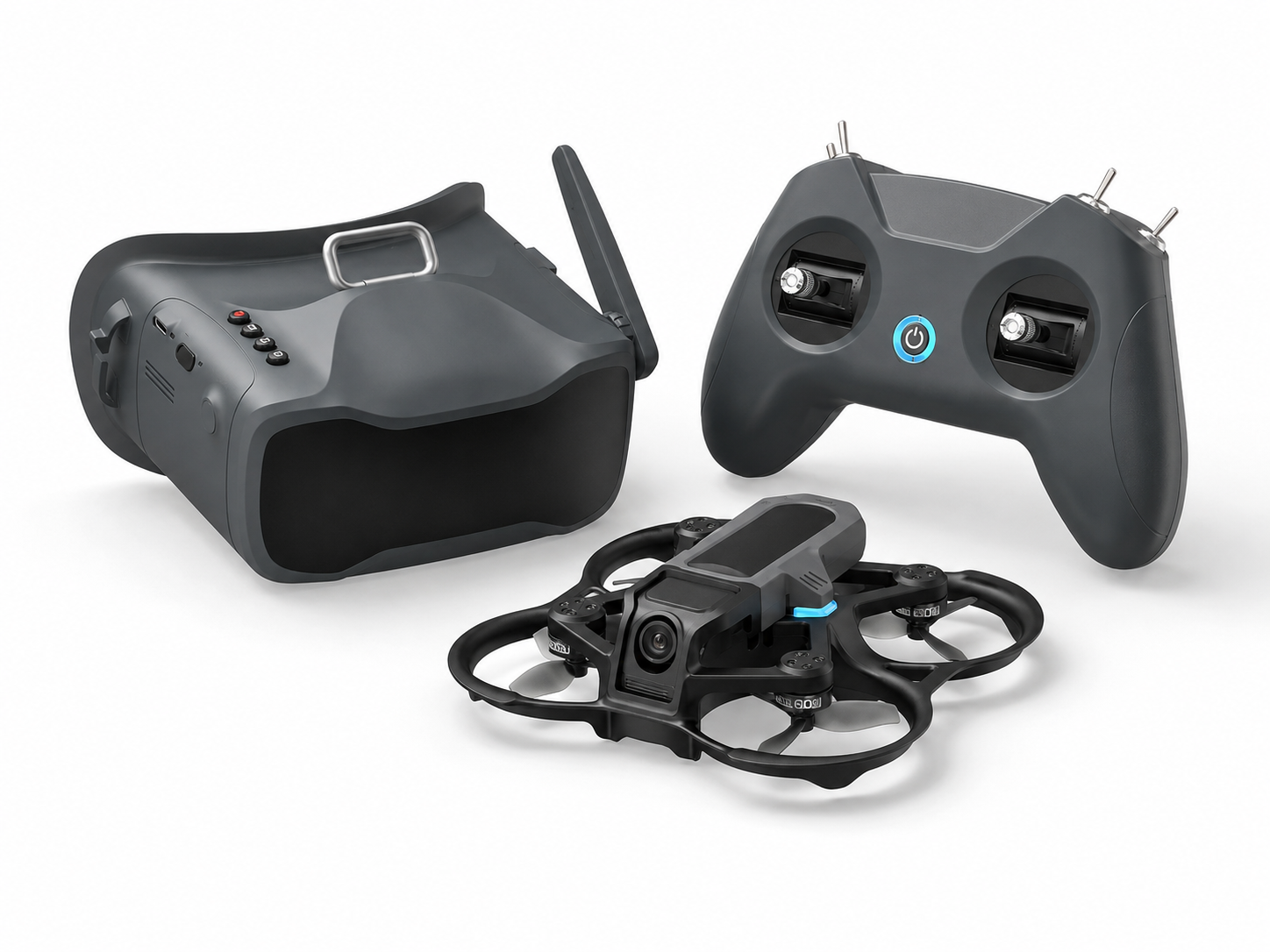
Best for Absolute Beginners
BETAFPV Aquila16 FPV Kit
Best for first-time FPV pilots who want a more stable, manageable way to complete their first flights and build basic control confidence.
Recommended package: BETAFPV Aquila16 FPV Kit
What’s included: Aquila16 drone, VR03 FPV goggles, LiteRadio 2 SE controller, one 1100mAh flight battery, battery charger, and carrying case.
What If You Want More Than the Basics?
The Aquila16 prioritizes stable, manageable first flights. If you already know you want a more immersive FPV experience with more room to grow, the DJI Avata 2 may suit you better.
Want More Immersion and Room to Grow?
DJI Avata 2
Choose the Avata 2 if you value Goggles 3, motion-based control, and a more immersive experience that can remain interesting as your confidence grows. The trade-off is a much higher price and a more substantial system to learn and manage.
What Makes It Beginner-Friendly
The Aquila16 combines Position Hold in N Mode, an enclosed frame around the propellers, and adjustable flight modes and speed settings to make the earliest stage of FPV learning more manageable. Together, these features reduce some of the initial control pressure and make minor mistakes less intimidating, without removing the need to practice.
N Mode Position Hold Reduces Early Control Pressure
Position Hold in N Mode helps keep the Aquila16 steadier while you practice basic direction and orientation. For a first-time pilot, that means fewer moments spent recovering from small control mistakes and more time building a feel for the sticks.
An Enclosed Frame Makes Minor Bumps Less Intimidating
The Aquila16’s enclosed frame surrounds the propellers, adding some protection during minor contact.
It does not make the drone crash-proof, and harder impacts can still cause damage. But during low-speed practice, the added protection can make small positioning mistakes feel less intimidating and help you stay focused on learning instead of worrying that every minor bump will immediately end the session.
Flight Modes and Speed Settings Give You Room to Progress
Its flight modes and adjustable speed settings let you increase the challenge without immediately replacing the kit. That gives absolute beginners some room to keep practicing after the earliest stage, even though the Aquila16 is still far more limited than a traditional modular freestyle FPV system.
Who the BETAFPV Aquila16 Is Best For
The BETAFPV Aquila16 makes the most sense for complete beginners who care more about completing their first flights with less control pressure than getting the sharpest goggle view, extensive customization, or long-term freestyle performance.
It Is a Strong Fit If You:
- Want a complete kit that removes the need to match separate components
- Prefer a steadier, lower-pressure way to build confidence during your first flights
- Value some added protection for the small bumps that can happen while learning
- Want some room to progress before deciding whether you need a more advanced drone
It May Not Be the Right Fit If You:
- Prioritize a sharper, more immersive goggle view over a lower-pressure start
- Want a more responsive flying experience with more room to grow beyond the basics
- Prefer a modular FPV setup you can build, tune, and repair yourself
Frequently Asked Questions
These answers cover a few final questions to consider before choosing the BETAFPV Aquila16.
Is the BETAFPV Aquila16 easy for a complete beginner to fly?
It can be, especially compared with starting on a traditional manual FPV setup. As a ready-to-fly beginner FPV kit, the Aquila16 includes the drone, goggles, controller, and basic flight gear in one package. Position Hold and slower speed settings can reduce some of the constant correction required while you learn basic stick control.
It is not hands-off, however, and you should still expect a learning period. Start in a clear, controlled area and give yourself time to understand how the drone responds.
Will I crash the Aquila16 easily while learning?
Not necessarily. The enclosed frame adds some protection around the propellers during light contact, while Position Hold and slower speed settings can help you practice with steadier control.
It is not crash-proof, and harder impacts can still cause damage. Practice in a clear, open area, and do not treat the protective frame as obstacle avoidance.
Will I outgrow the Aquila16 quickly?
Probably not right away. Its flight modes and speed settings give you some room to move from a more assisted start toward faster, more direct control as your confidence grows.
You may eventually want to upgrade if a sharper goggle view, more responsive flying, or modular customization becomes important to you.
Do I need to register the Aquila16 in the United States?
For recreational flying in the United States, the Aquila16 is generally below the FAA’s 250-gram registration threshold in its standard configuration, so registration is usually not required.
You still need to complete the free TRUST safety test and follow the FAA’s recreational flying rules. TRUST is short and online, there is no in-person exam, and incorrect answers can be corrected before you receive your completion certificate.
Requirements can change, so it is worth checking the current FAA guidance before you fly.